3.2 | 생물학적 촉매로서의 효소Enzymes as Biological Catalysts
(19세기 말) 에탄올 형성과정에서, 효소세포가 꼭 온전해야만 하는 걸까...??
- Justus von Liebig: 알코올을 생성하는 이런 발효반응이, 시험관에서 연구한 유기반응과 별반 다르지 않다고 주장
- 루이파스퇴르: 발효과정이란 온전하고, 고도로 조작화된 살아있는 세포범위 내에서만 발생하는 것이라고 얘기함!
Hans Büchner/ Eduard 형제 : 효모 주스jugo de levadura 만드는 법^^
발효과정 메커니즘을 발견한 실험!
1. 효모세포를 흙 알갱이로 갈은 다음,al tritular celula de levadura con granos de arena갈아만든효모알갱이
2. 거름종이papel filtro에 혼합물을 걸러서 만든 추출물extrato obtenido이당
- 방부제antiseptico로 보존하려고 함 ⇀ 실패!
- 잼처럼 설탕 음청나게 넣어서 부패descomposicion를 방지함 ⇀ 보존이 아니라 설탕에서 가스가 생성되자나...?? 에이 잠깐 이러고 말겠지 했더니 며칠동안 거품이 나네...?? 이게 뭐여
➡ 형. 내가 화학자자나. 낸테 맞겨! 해가지고 Eduard가 관찰한 결과, 발효과정에서 에탄올과 이산화탄소가 생성되서 이렇게 거품이 일어난다는 걸 발견했다. 오... 지금은 너무 당연한 화학식인데 이때는 신기했겠구낭

➡ Büchner: 발효가 꼭 온전한 세포celula intacta 일 필요는 ㄴㄴ한걸 발견함
발효fermentacion
- 에탄올가스 C2H5OH
- 이산화탄소 거품 CO2 생성!
- 특징:
- 유기화학과는 매우 다른 반응을 생성함forma muy distinta de los quimicos organicos
- 효소의 존재하에 진행되는 반응이다
*효소: 무생물inanimados과는 반응하지 않는contraparte 촉매제catalizador
효소enzima

단백질이며, 대부분의 경우 보조인자cofactores를 가지는 결합단백질proteina conjugada이다
- 어원적 의미: 그리스어로 효모levadura를 뜻한당
- 세포네 거의 모든 반응을 담당하는 신진대사의 매개체mediadora del metabolismo
- 만약에 효소가 없다? 대사반응이 일어나지 않을까? ㄴㄴ그건 아님. 효소는 없는반응을 만들어내는게 아니라, 속도에만 관여하는 것이므로 효소가 없어도 반응은 일어나지만 거의 일어나는지 안 일어나는지 모를정도로 천~~~~천히 진행되게됨
보조인자
- 비단백질 구성요소grupo prosteticos
- 무기물inorganicos (금속)
- 유기물organicos (조효소coenzima; 비타민이나 비타민에서 온것들)
- 역할: 효소 기능에 중요한 역할을 하게됨, 주로 아미노산이 못하는 일을 해주는 아이.
ex) 미오글로빈의 grupo hemo (철원자): 산소가 결합해서 세포대사에 쓰이는 O2를 저장한다!
+) 효소가 단백질이라는 증거 (연구자: James Sumner)
- 작두콩habas espada의 효소 요소urea분해효소를 결정화하고, 구성요소를 밝혀냄
- 당시에는 인정ㄴㄴ, 이후에 모든 생물학적 촉매제가 전부 단백질이라는 걸 인정하게 됨!
++) 리보자임: 생물학적 반응을 RNA 분자에 의해 촉매하는 녀석ciertas reacciones biologicas estan catalizada por moleculas RNA
< 리보자임과 효소의 차이점 >
| 효소enzima | 리보자임ribozima |
| 일반적으로 단백질 촉매제를 뜻함termino general para las catalizadores proteicos | RNA 촉매에서 사용되는 촉매제로 구분한당 |
cap. 11: RNA 촉매와 특성

효소의 특징The Properties of Enzymes
1. 소량만 필요함se requiere en pequeña cantidades
2. 촉매작용을 한다
- 기질sustrato: 효소를 통해 결합된 반응물
ex) 헥소키니아제효소hexocinasa: 기질인 포도당 외, 100개의 저분자화합물과 함께 용액에 있으면 포도당만 효소에 인식되서 반응을 겪게 됨. 오,,,, 뭔가 바코드 찍는 느낌이당
실용적인 목적을 위해 다른 화합물이 존재하지 않을수도 있음!
효소-기질-단백질 특이성: 결합물질간의 특이성 덕에 생명유지에 필요한 질서를 유지할 수 있다
정리하자면,
1. 높은 수준의 활성
↪ 특정시간에 세포의 요구를 충족하도록 조절도 가능하다
2. 특이성을 가짐
↪ 매우 질서정연하기때문에 대사의 교통을 감독할 수 있음
3. 적당한 양의 생성물을 형성함
↪ 화학부산물 형성이 세포수명에 영향을 끼침으로 매우 중요함!
활성화 에너지 장벽 극복Overcoming the Activation Energy Barrier
왜 효소는 열역학적인 반응을 이끌어 낼 수 없는데, 효소의 유무다 속도를 관여할 수 있을까? 가수분해가 잘되는 ATP도 효소반응으로 조절되어 분해될 때까지는 세포내에서 안정적인 상태임. 이게 진짜 중요한 관계자나 말하자면 ATP off 에서 on 으로 바꾸어준다는데 그걸 어떻게 효소가 하냐는 거징.
활성화에너지energía de activación (EA)

- 반응과정중 화학반응은 공유결합enlace covalente를 끊어야 함. 이를 위해서 반응물은 일정한 에너지가 필요함
- 이때 필요한 에너지가 바로 활성화 에너지!!
- 이 활성화에너지라는 장벽을 넘으면, 반응이 일어나게 되는거징!!
실온용액의 분자: 무작위적인 운동상태로 존재하고, 주어진 시간동안 일정량의 운동에너지를 가짐 (오 뭔가 물리적으로 얘기하면 MU같은느낌)
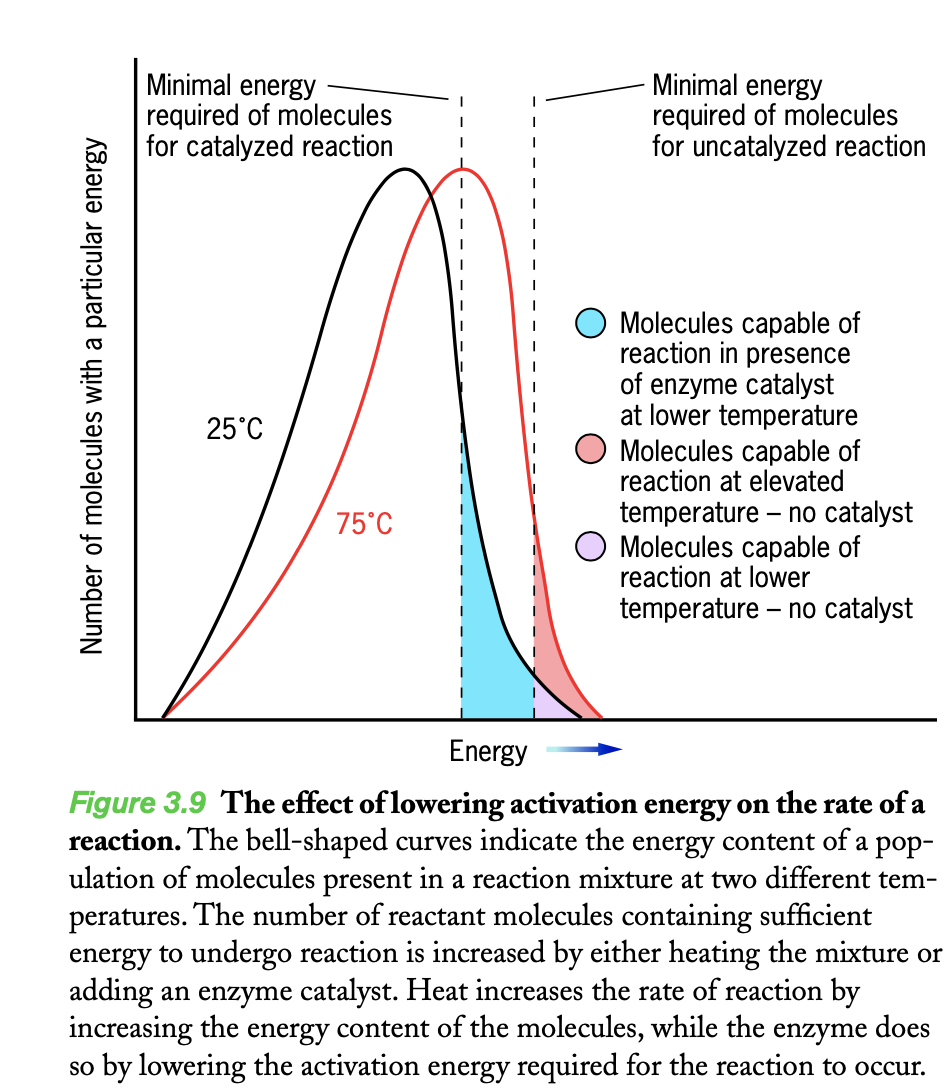
- 분자에너지는 산 모양의 곡선을 이루게 됨, 그이까 에너지분포차가 심하다는 거징.
- 고에너지 분자 (=활성된 분자): 짧은 시간동안 충돌에 의해서 다른분자에게 과잉에너지exceso de energia를 잃음
- 한 반응물분자가 두개의 생성물로 분할될때
- 이 반응물분자가 활성화 장벽을 극복하기에 충분한 에너지, 즉 활성화에너지를 얻으면, 2개의 생성물 분자로 분할하게된다!
- 반응속도: 주어진 시간동안 운동중인 반응물의 분자수에 따라 변화!
효소와 활성화 에너지
- 효소의 역할은 활성화 에너지 장벽을 내려서disminucion de la barrera de EA 반응이 더 쉽게 일어나도록 도와주는 것
- 열에 의한 촉매작용과는 다르게, 에너지 수준을 올릴필요 없이 기질을 반응성으로 만들어 준다!
- 효소: 반응물보다 전이상태에 더 단단히 결합하며 생긴 효소-기질 복합체가 활성화된 복합체를 안정화시켜서 활성화에너지를 낮춘다!
반응물/전이상태: 기하학적구조, 결합특성이 달라지게 되는데 이게 결국 효소 메커니즘에서 매우 중요한 과정이라는 겨.
■ 반응전이상태와 유사한 화합물: 효소 촉매영역region catalitica에 매우 밀접하게 결합할 수 있음
↪ 반응을 매우 효과적으로 억제하게 됨!
■ 항체anticuerpo: 효소와는 달리 단순 높은 친화력으로 분자와 결합하는 아이
↪ 반응을 매우 효과적으로 억제하게 됨!
↪ 반응전이상태와 비슷한 화합물에 결합하는 항체는 효소처럼 작용해서 분해를 촉매할 수도 있당!
↪ 전이상태가 생성물로 전환됨 ⇀ 결합된 분자의 효소친화도 감소 ⇀ 생성물 배출됨!!
반응 속도를 어떻게 올릴까?
- 반응물의 에너지 높이기= 반응 혼합물 가열! (but. 반응중인 효소에 열을 가하면 얘도 단백질이라 변성이 발생 ⇀ 효소가 비활성화된다!!
전이상태estado de transicion:
- 반응물이 거의 정상의 에너지까지 도달하고, 생성물로 전환되기 직전의 상태
- 방응물의 결합이 형성되고, 끊어지는 일시적이며 활성화된 복합체를 형성함!
ex) 프롤린 리세마제 (박테리아 효소)
- 촉매반응을 통해 프롤린 D,L 입체이성질체의 상호작용을 연구
↪ 전이상태구조의 특성을 알 수 있다!

프롤린 분자의 알파탄소가 양쪽의 양성자를 잃으면서 진행됨
↪ 전이상태의 구조: 탄소음이온carbanión 을 가짐
탄소음이온: 탄소에 의해 형성된 같은선상에 있는 3개의 결합
< 표준자유에너지와 활성화 에너지의 비교>
| 여러반응의 표준자유에너지energia libre estadar | 활성화에너지(EA) |
| 고정된 값 | 반응 메커니즘에 따라 값이 달라진다! |
활성부위The Active Site
- 기질결합에 직접 관여하는 효소분자의 일부분
- 상보적인 모양formas complementarias을 가짐 ⇀ 더 정밀하게 결합 할 수 있당!
- 활성부위의 역할, 특징:
- 기질 결합
- 기질에 영향을 미침
- 반응의 활성화에너지를 낮추는 특정 곁사슬 배열을 가짐
↪ 이 곁사슬의 중요성은 부위 특이적 변이site-directedmutagenesis 을 통해 알 수 있슴
↪ 곁사슬의 반응성: 세포내 수성용매solvente acuoso 와 비교했을때 훨씬 더 높다!
*부위 특이적 변이site-directedmutagenesis: 유전자의 특정한 염기 혹은 염기 배열을 인공적으로 변환하여 발생시킨 돌연변이.
- 일반적으로 수성환경acuoso에서 단백질의 틈hendidura,grieta사이나 틈에 뭍혀있음
↪ 기질이 이 틈 안으로 들어가면, 일반적으로 결합된 물 분자를 버리고 (탈용매화, 탈수desolvatacion) ⇀ 소수성 환경ambiente hidrófobo 으로 들어가게 됨
- 활성부분을 구성하는 아미노산: 길게 확장된 폴리펩타이드 사슬을 따라서 멀리에 위치하지만, 3차구조에서 접히게 되면 서로 밀접하게 된당
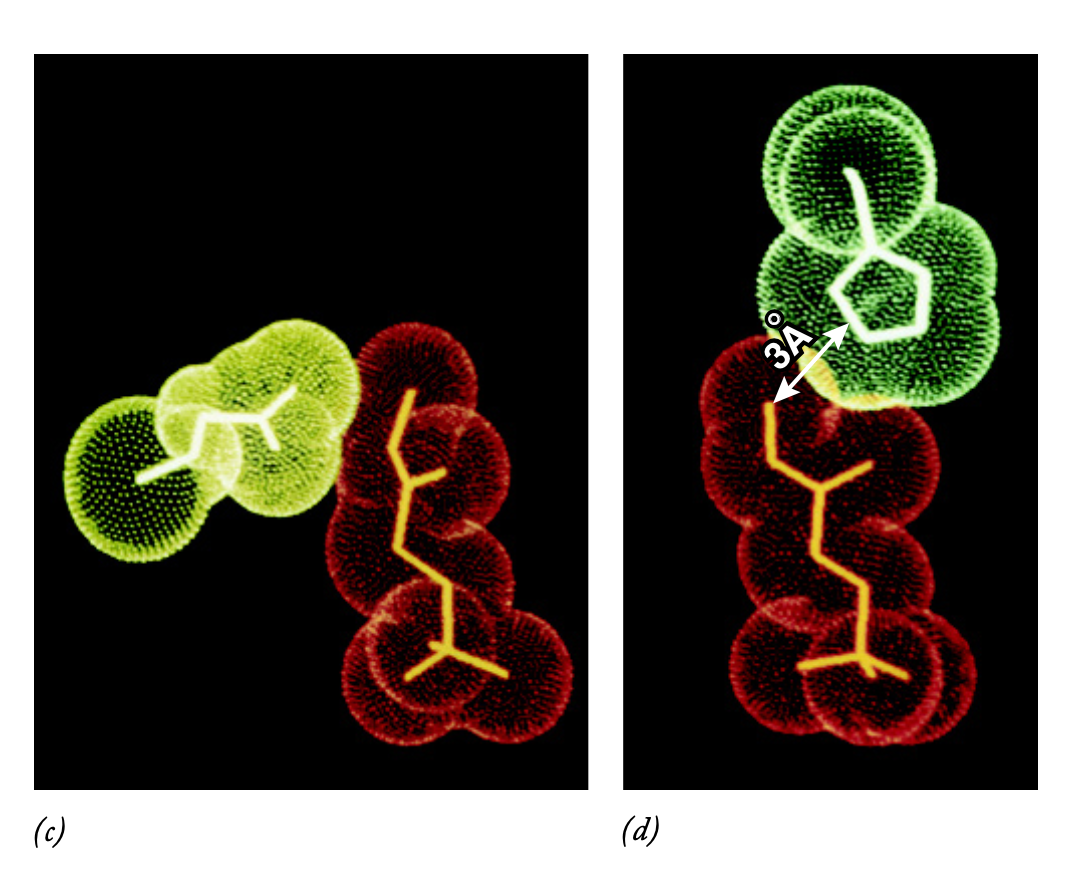
- 활성부위 구조 특이성: 대부분의 효소는 밀접한 관련이 있는 생물학적 분자 하나이상, 어쨋든 소수에만 결합함
효소-기질 복합체 (ES)complejo enzima - sustrato

- 반응물+효소 결합으로 생성되는 복합체
- 이 복합체를 형성하여 반응물끼리의 활동에 밀접하게 관여하여, 효소의 결합이 파괴되고, 형성되는 과정을 가속화 시켜줄 수 있는겨!
- 대부분은 비공유 결합no covalente, but 일시적 공유결합enlace covalente transitorio을 형성하기도 함
기질-효소 결합
- 단백질 구조를 결정하는 비공유상호작용 (이온결합/수소결합/소수성 상호작용)으로 이루어진당
ex) 효소: 음전하 원자를 결합하기 위해 많은 양의 양전하잔기를 가지고 있는겨

효소 촉매의 메커니즘Mechanisms of Enzyme Catalysis
효소가 없으면 엄청나게 느렸던 반응이 어떻게 효소가 반응하면 초당 수백번 발생시킬 수 있을까?
핵심은 효소-기질 복합체(ES) 형성에 있슴!
↪ 기질을 액체solucion에서 꺼낸다음 큰 촉매분자 표면에 고정되게 한당
↪ 이후 기질의 물리/화학적 특성이 여러방식으로 영향을 받게될 수 있당.
기질 방향성Substrate Orientation
에어팟이 그대로 안에 남아있을까? ㄴㄴㄴㄴ^^;;
하지만 에어팟케이스 한쪽으로 잡고 다른한손으로 에어팟을 케이스에 넣으면 잘 부차되징. 이렇게 방향성을 유지하게되면 계sistema의 엔트로피가 엄청 줄어들지! 이런 역할을 하는게 바로 효소의 역할이다.
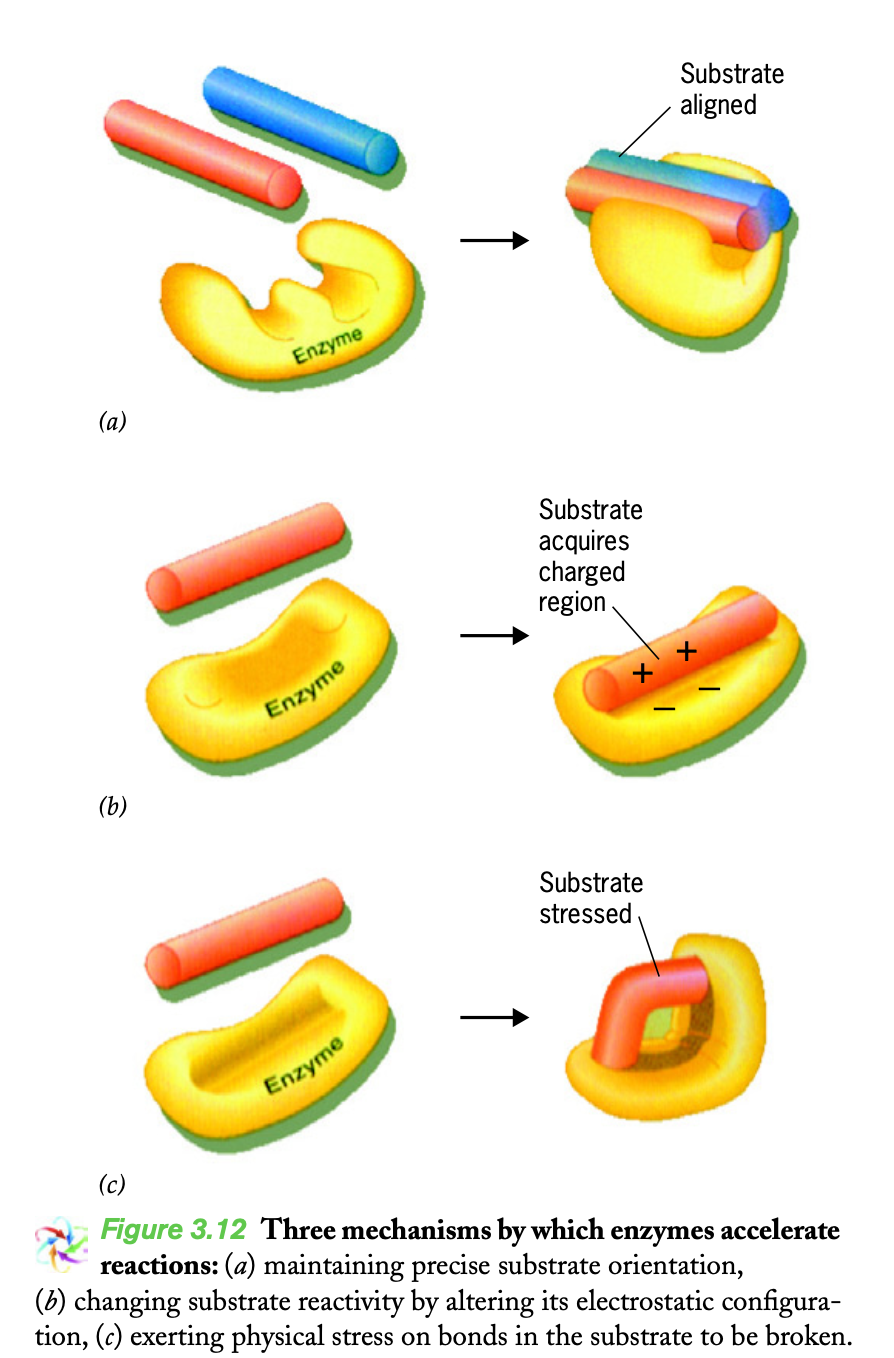
효소표면에 결합한 기질: 반응을 일으키기위해 정확한 방향으로 매우 가깝게 결합된다(그림 3.12a).
반응물이 용액에 존재하면 얘네는 이동translacion이나 회전운동rotacion을 겪고, 에너지가 충분하더라도 전이상태의 복합체를 형성하기위한 충돌을 항상 겪지는 않음!
기질의 반응성 변화시키기Changing Substrate Reactivity
효소: 완전한 전하를 가지는것부터~ 높은 극성을 가진것까지 다양한 유형의 곁사슬을 갖는 아미노산으로 이루어진당기질이 효소표면에 결합할때, 기질 분자내 전자분포는 효소의 가까운 곁사슬에 영향을 받게 된당(그림 3.12b)
↪ 열같은 외부에너지energia externa 영향없이 일어나게됨!
효소와 기질의 결합을 통해 반응성이 높아지는 메커니즘
1. 유기반응 메커니즘을 과 매우 비슷함
↪ 반응속도: pH (산성도)변화에 큰 영향을 받는다! 오,, 이거 몰랐다. 별표 🔅🔅
↪ 효소는 배양지medio의 산성도를 변화시킬 수는 없지만, 산성/염기성 곁사슬을 가진 수많은 아미노산을 가진당. 얘네들은 기질이나 기질사이에서 양성자를 제공donar하거나 받을quitar수 있기때문에, 기질의 정전기적 특성을 변화시켜서 더 반응성있는 기질이 되도록 한당
효소의 활성부위sitios activos de enzimas
- 부분적 양전하/음전하를 띠는 곁사슬을 가진당
↪ 기질과 상호작용하여 기질의 정전기적 특성propiedades electrostaticas (그림 3.12b), 반응성을 변화시킴
↪ 기질과 반응하여 일시적 효소-기질(ES) 공유결합 형성할 수 있당
【생물학】 2-1강. 단백질 분해효소 메커니즘
단백질 분해효소 메커니즘 추천글 : 【생물학】 2강. 세포와 물질대사 Q. 일반적으로 생화학반응에서 카르보닐기(C=O)는 친핵체(nucleophile)의 공격을 받는 원자이다. 따라서 폴리펩타이드 체인
nate9389.tistory.com
ex) 키모트립신quimotripsina
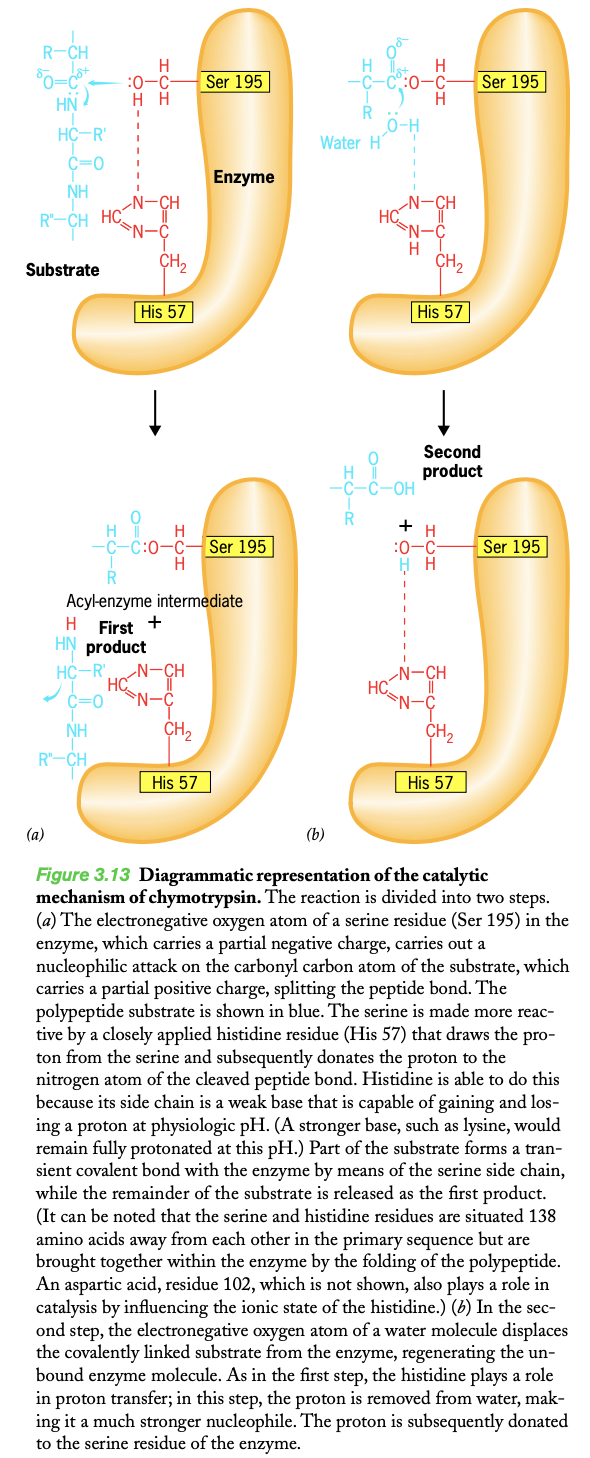
- 소장intestino delgado에서 음식단백질을 소화시키는 효소
- 기질 단백질의 펩티드결합을 가수분해한당
- 두가지 단계로 나뉨
- 효소에 있는 세린 곁사슬: 전기적으로 음성인 산소원자가 기질의 탄소를 공격한당(친핵체 공격)
↪ 기질의 펩티드 결합이 가수분해됨
↪ 세린과 기질 사이에 공유 결합이 형성되고, 기질의 나머지 부분을 생성물productos의 하나로 대체시킨당
➡ 세린근처 히스티딘 잔기가 이런반응을 일으키는겨. 얘네가 세린 수산기그룹의 양성자를 끌어당겨서 그룹 산소의 친핵력을 증가시키기 때문이다!
- (2단계): 효소-기질 공유결합이 물분자를 통해 절단됨
↪ 효소: 결합되지 않은 상태로 돌아감,
↪ 기질: 두번째 생성물로 배출된다
➡ 효소가 촉매반응에서 물분자를 어떻게 이용하는지 알 수 있당!
아미노산 곁사슬
- 다양한 반응에 관여
- BUT, 전자를 기증하거나, 받는데에는 알맞지 않당
전자전달: 산화-환원의 핵심, 세포대사에서 매우 중요!
아미노산으로 이루어진 단백질인 효소가 그럼 어떻게 이런역할을 도울까? 바로 보조인자cofactores의 도움덕이 가능!
보조인자cofactores: 대부분의 효소는 활성부위의 아미노산 잔기 하나를 화학적으로 변형시켜서 전자수용체인 보조인자를 생성하게 된당.
- 무기이온 (금속)
- 조효소coenzima
기질에 변형 유도Inducion de tension en el sustrato
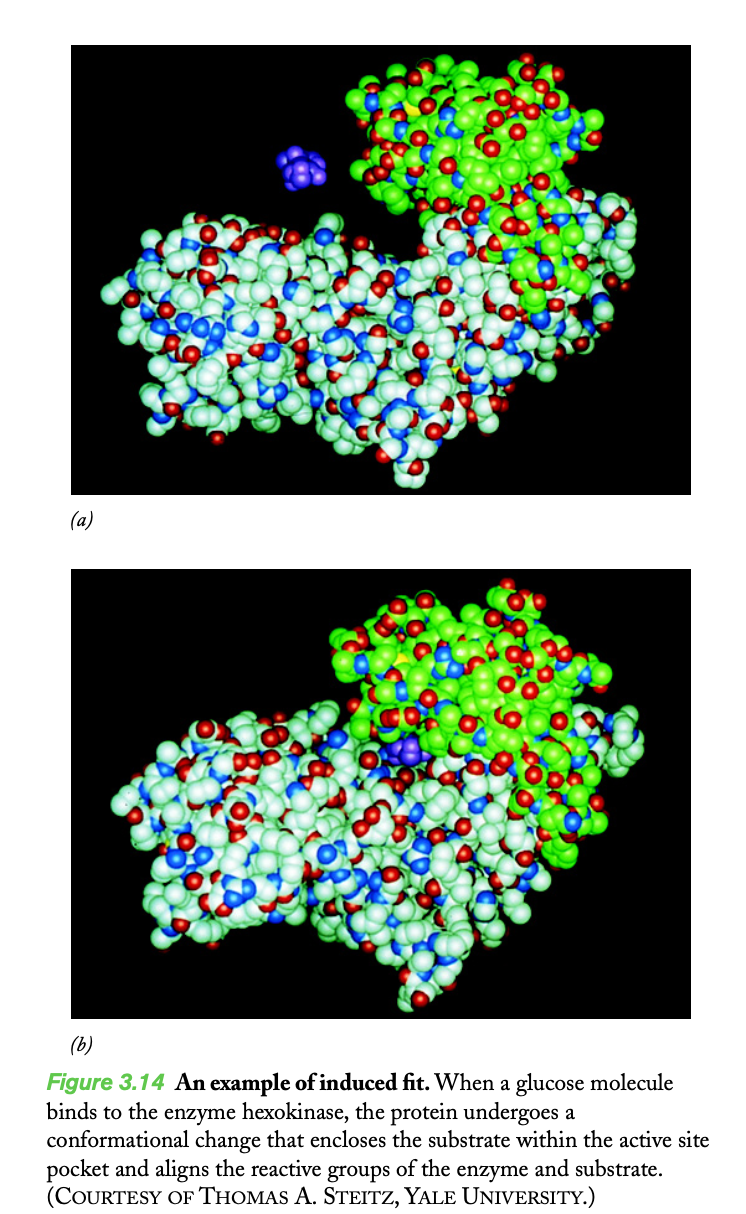
효소 활성부위는 기질과 처음부터 상보적일 수도 있고, 기질이 결합되어 효소특정 원자의 위치가 이동되기도 한당.
이렇게 구조가 변화되면 효소/반응물 사이의 유도적 조절ajuste inducido덕에 효소가 적절히 반응할 수 있는 쪽으로 이동하게됨!
↪ 이러한 분자내 움직임 덕에 구조적 변화가 발생하면, 기계적으로 작업을 수행하여 기질분자내 결합에 물리적힘을 가한당
↪ 기질을 불안정하게 만들어 변형이 안정될 수 있도록 전이상태를 유지하게 만든당 (그림 3.12c).
구조적 변화 및 촉매 중간체 연구Studying Conformational Changes and Catalytic Intermediates
효소의 촉매 메커니즘: 반응 진행에따른 효소, 기질의 원자/전자구조 변화를 알아야 한당
- X선 결정학: 효소분자의 세부적인 부분을 연구할 수 있음
↪ 시간- 상분해 결정학time-resolved crystallography(cristalografia resuelta en tiempo): 신기술을 이용하면 반응 주기동안 효소가 촉매반응을 일으키는 동안 활성부위에서의 일시적 구조변화를 관찰할 수 있게 됨
- 단백질 결정체의 40~60%: 갇혀있는 용매solvente atrapado로 이루어져 있음 ⇀ 대부분의 결정화된 효소는 높은 효소활성을 유지하게된다!
- X선 회절difracción: 반응 메커니즘을 연구할 수 있당! (but. 시간적 제약이 따름)
↪ 빅데이터 수집을 위해 몇시간/며칠동안 X선을 관찰해야함... 뭔가 그거같음 그 천체 사진찍을때 막 밤새면서 별의 이동경로 관찰하는 느낌...
↪ 이렇게 수집한 데이터를 통해 평균적인 분자구조를 알 수 있는것
■ 싱크로트론sincroton에서 생성되는 초고강도ultra alta intensidad X선을 이용함
↪ X선에 노출되는 시간을 피코초picosegundos 단위로 줄일 수 있음 = 효소가 화학변형transformacion quimica을 촉매하는데 걸리는 시간!
*싱크로트론sincroton: 아원자 입자particulas subatomicas를 연구하는 데 사용하는 기기
■ 효소결정을 영하cero absoluto 20-40도 정도에서 냉각
↪ 반응속도가 100억배 느려짐 (온도가 높을수록 반응 빨라진당!^^) ⇀ 일시적 중간체intermediarios transitorios의 수명을 늘려준다
■ 결정의 모든 효소가 동시간대에 동일한 반응단계에 있도록, 전체 결정에 결쳐서 반응을 동시에 촉발함
ex) 기질이 ATP일때: 효소결정이 반응하지 않은no reactivas ATP 분자와 함께 침투infiltrarse 한다
↪ 결정이 짧은 빛pulso breve de luz에 노출되면, 갇혀있던 ATP분자가 모두 방출되고, 결정전체의 활성부위가 동시에 반응을 시작하는 것!
*반응하지 않은no reactivas ATP 분자란? 광감성sensible a la luz 결합을 통해 불활성기grupo inerte (ex: 니트로페닐기)와 연결된 분자를 뜻함
■ 부위 특이적 돌연변이 효소 (페이지 74)를 이용하여 반응의 특정단계에 운동장벽kinetic barriers을 만듦impose
↪ 특정 중간체의 수명을 연장시킨다
■ 초-고 분해능resolucion ultra-alta (원자력) 구조 결정(ex: 0.8 Å)
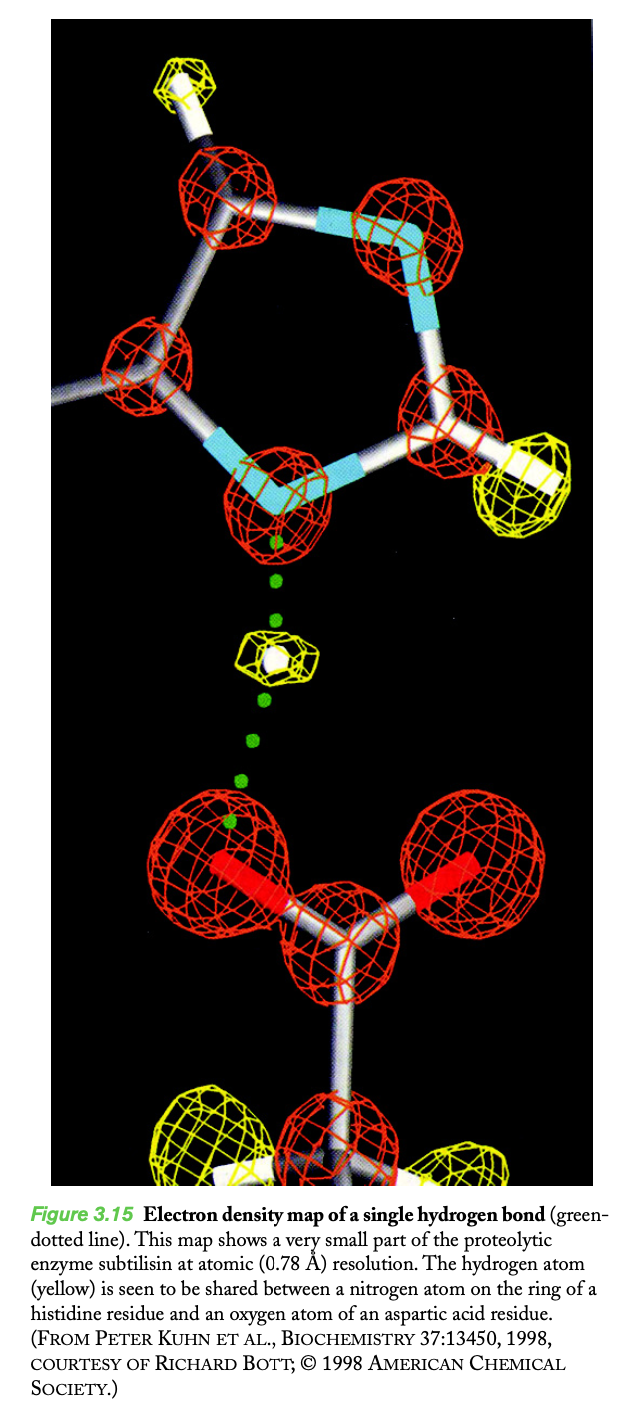
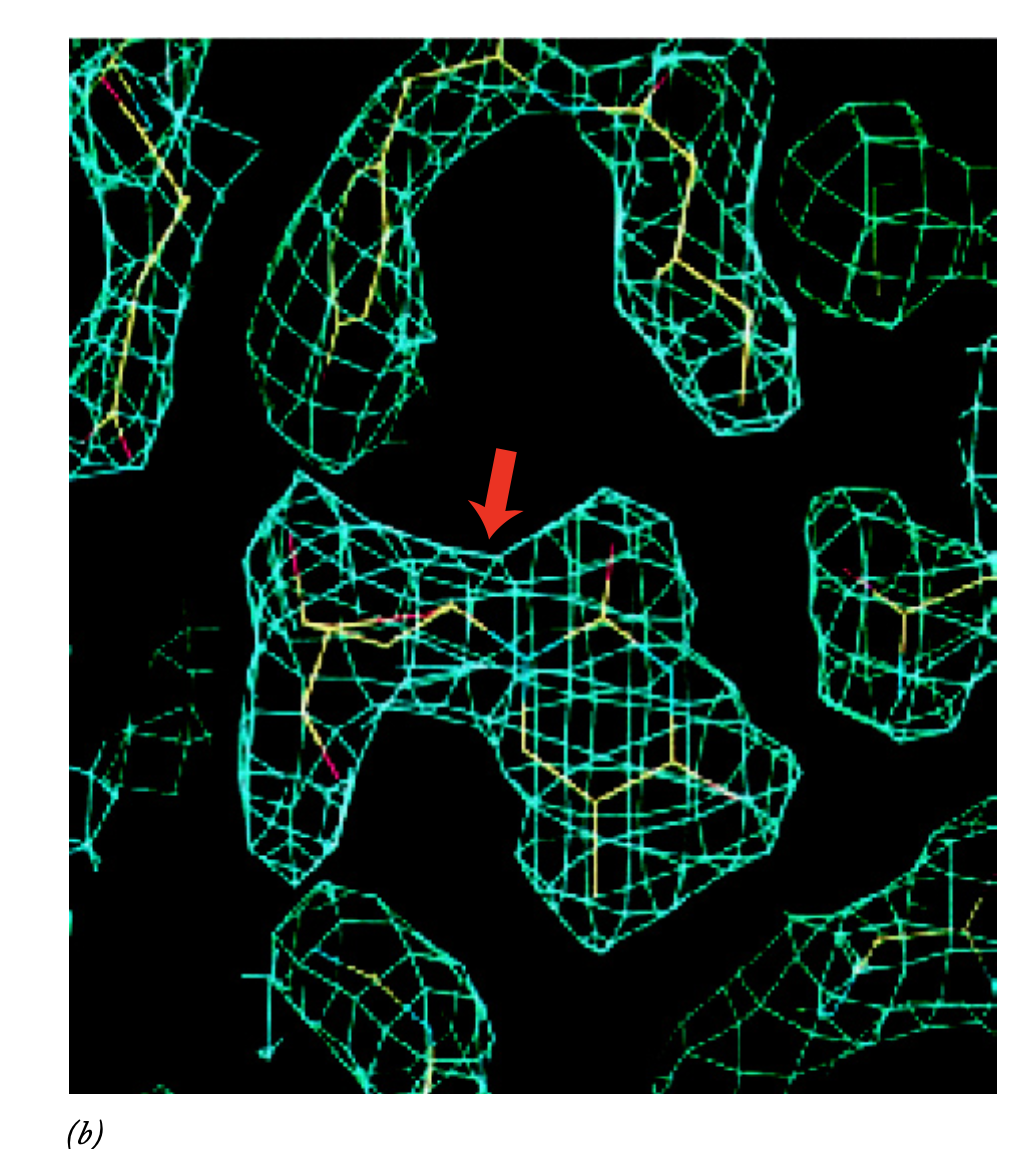
↪ 수소결합이나 산성기를 가진 단백질과 연관된 것들에 주로 존재하는 수소원자를 시각화 할 수 있다! 아 마자 저거 수소 지름이었음...o.o....
↪ 물분자 결합의 존재 유무/ 촉매 곁사슬의 미세한 구조conformacion precisa de las cadenas laterales cataliticas도 시각화 가능
↪탈수작용동안 기질 부분에 나타나는 약한 장력sutil tension도 관찰 할 수 있다
옆에 그림 3. 15 : 수소결합을 고해능 이미지로 나타낸것! 이런식으로 다양한 정보를 얻을 수 있음
위에서 설명한 다양한 기술을 섞어서 한 탈수작용 동안의 연속적으로 변화하는etapas sucesivas 효소의 3차구조를 결정할 수 있게 됨
- 이렇게 각 사진을 순서대로 모아두면 반응의 진행에 따라 나타나고, 사라지는 다양한 촉매 중간체가 나타나는 동영상(pelicula)이 생성된다!
이러한 기술을 결합함으로써 연구자들은 단일 촉매 반응 동안 연속적인 단계에서 효소의 3차원 구조를 결정할 수 있었습니다. 이러한 개별 "스냅샷"이 순서대로 결합되면 반응이 진행됨에 따라 나타나고 사라지는 다양한 촉매 중간체를 보여주는 "동영상"이 생성됩니다. 이러한 접근 방식 중 여러 가지를 사용하여 수집할 수 있는 데이터의 예는 그림 3.16에 나와 있습니다.
효소가 기질을 산물로 변형시키는 과정에서 일어나는 구조적 변화에 주목해 왔지만, 최근에는 단백질 자체 내에서 일어나는 구조적 변화에도 상당한 관심을 기울이고 있다. 그림 2.37에서 볼 수 있듯이 단백질은 중요한 기능적 관련성을 가질 수 있는 기본 제공(고유) 동작이 가능한 동적 분자입니다. 그림 2.37에 묘사된 경우, 이 움직임은 기질이 효소의 활성 부위로 들어가는 것을 허용합니다. 다양한 실험 기술을 통해 이러한 유형의 고유 운동을 분석한 결과, 기질이 없는 경우에도 단백질은 단백질의 촉매 주기 동안 감지할 수 있는 동일한 운동을 많이 할 수 있음을 시사했습니다. 만약 사실이라면, 이것은 단백질이 제공할 수 있는 잠재적 기능에 유용할 수 있는 고유한 운동이 가능한 단백질 구조를 진화가 선택했음을 시사합니다. 특정 형태의 변화를 유도하기 보다는 기질(들)은 단순히 단백질이 효과적으로 결합할 수 있는 형태를 취하기를 "기다리는" 것일 수 있습니다.
By combining these techniques, researchers have been able to determine the three-dimensional structure of an enzyme at successive stages during a single catalyzed reaction. When these individual “snapshots” are put together in se- quence, they produce a “movie” showing the various catalytic intermediates that appear and disappear as the reaction pro- ceeds. An example of the data that can be collected using sev- eral of these approaches is shown in Figure 3.16.
While the spotlight has been focused on the conforma- tional changes that occur as an enzyme transforms its sub- strates into products, considerable attention has also been paid in recent years to the conformational changes that occur within the protein itself. As shown in Figure 2.37, proteins are dynamic molecules that are capable of built-in (intrinsic) mo- tion that can have important functional relevance. In the case depicted in Figure 2.37, this motion allows entry of substrate to the enzyme’s active site. Analysis of this type of intrinsic motion by various experimental techniques has suggested that proteins—even in the absence of substrate—are capable of many of the same movements that can be detected during the protein’s catalytic cycle. If true, this suggests that evolution has selected for protein structures that are capable of intrinsic mo- tions that can be useful for potential functions that a protein might serve. Rather than inducing a specific conformational change, the substrate(s) might simply be “waiting” for a pro- tein to assume a conformation to which it can bind effectively.
Enzyme Kinetics
Enzymes vary greatly in their ability to catalyze reactions. The catalytic activity of an enzyme is revealed by studying its kinetics, that is, the rate at which it catalyzes a reaction under various experimental conditions. In 1913, Leonor Michaelis and Maud Menten reported on the mathematical relationship between substrate concentration and the velocity of enzyme reactions as measured by the amount of product formed (or substrate consumed) in a given amount of time. This relation- ship can be expressed by an equation (given on p. 103) that generates a hyperbola, as shown in Figure 3.17. Rather than considering the theoretical aspects of enzyme kinetics, we can obtain the same curve in a practical manner, as it is done for each enzyme studied. To determine the velocity of a reaction, an incubation mixture is set up at the desired temperature, containing all the ingredients required except one, which when added initiates the reaction. If, at the time the reaction begins, no product is present in the mixture, then the amount
of product that appears over time provides a measure of the velocity of the reaction. There are complicating factors in this procedure. If the incubation time is too great, the substrate concentration becomes measurably reduced. In addition, as product appears, it can be converted back to substrate by the reverse reaction, which is also catalyzed by the enzyme. Ide- ally, what we want to determine is the initial velocity, that is, the velocity at the instant when no product has yet been formed. To accurately measure the initial reaction velocity, brief incubation times and sensitive measuring techniques are employed.
To generate a curve such as that shown in Figure 3.17, the initial velocity is determined for a series of incubation mix- tures that contain the same amount of enzyme but an increas- ing concentration of substrate. It is evident from this curve that the initial reaction velocity varies markedly with substrate concentration. At low substrate concentrations, enzyme mol- ecules are subjected to relatively few collisions with substrate in a given amount of time. Consequently, the enzyme has “idle time”; that is, substrate molecules are rate limiting. At high substrate concentrations, enzymes are colliding with substrate molecules more rapidly than they can be converted to product. Thus, at high substrate concentrations, individual enzyme molecules are working at their maximal capacity; that is, en- zyme molecules are rate limiting. Thus, as a greater and greater concentration of substrate is present in the reaction mixture, the enzyme approaches a state of saturation. The ini- tial velocity at this theoretical saturation point is termed the maximal velocity (Vmax).
The simplest measure of the catalytic activity of an en- zyme is provided by its turnover number, which can be calcu- lated from the Vmax. The turnover number (or catalytic constant, kcat, as it is also called) is the maximum number of
molecules of substrate that can be converted to product by one enzyme molecule per unit time. A turnover number (per sec- ond) of 1 to 103 is typical for enzymes, although values as great as 106 are known (see Table 3.3). It is apparent from these values that a few molecules of enzyme can rapidly con- vert a large number of substrate molecules into product.
The value of Vmax is only one useful term obtained from a plot such as that in Figure 3.17; another is the Michaelis con- stant (KM), which is equal to the substrate concentration when the reaction velocity is one-half of Vmax. As its name implies, the KM is constant for a given enzyme and, thus, in- dependent of substrate or enzyme concentration. The rela- tionship between Vmax and KM is best appreciated by considering the Michaelis-Menten equation, which can be used to generate the plot shown in Figure 3.17.
According to the equation, when the substrate concentration [S] is set at a value equivalent to KM, then the velocity of the reaction (V ) becomes equal to Vmax/2, or one-half the maxi- mal velocity. Thus, KM [S], when V Vmax/2.
To generate a hyperbolic curve such as that in Figure 3.17 and make an accurate determination of the values for Vmax and KM, a considerable number of points must be plotted. An eas- ier and more accurate description is gained by plotting the re- ciprocals of the velocity and substrate concentration against one another, as formulated by Hans Lineweaver and Dean Burk. When this is done, the hyperbola becomes a straight line (Figure 3.18) whose x intercept is equal to 1/KM, y in- tercept is equal to 1/Vmax, and slope is equal to KM/Vmax. The values of KM and Vmax are, therefore, readily determined by extrapolation of the line drawn from a relatively few points.
In most cases, the value for KM provides a measure of the affinity of the enzyme for the substrate. The higher the KM, the greater the substrate concentration that is required to reach one-half Vmax and, thus, the lower the affinity of the
enzyme for that substrate. The KM for most enzymes ranges between 101 and 107, with a typical value about 104 M. Other factors that strongly influence enzyme kinetics are the pH and temperature of the incubation medium. Each enzyme has an optimal pH and temperature at which it operates at maximal activity (Figure 3.19). The influence of temperature on enzyme activity is illustrated by the striking effect of refrig- eration in slowing the growth of microorganisms.
Enzyme Inhibitors Enzyme inhibitors are molecules that are able to bind to an enzyme and decrease its activity. The cell depends on inhibitors to regulate the activity of many of its enzymes; biochemists use inhibitors to study the properties of enzymes; and many pharmaceutical companies produce en- zyme inhibitors that act as drugs. Enzyme inhibitors can be divided into two types: reversible or irreversible.
Irreversible inhibitors are those that bind very tightly to an enzyme, often by forming a covalent bond to one of its amino acid residues. A number of nerve gases, such as diiso- propylphosphofluoridate and the organophosphate pesticides, act as irreversible inhibitors of acetylcholinesterase, an en- zyme that plays a crucial role in destroying acetylcholine, the neurotransmitter responsible for causing muscle contraction. With the enzyme inhibited, the muscle is stimulated continu- ously and remains in a state of permanent contraction. As discussed in the accompanying Human Perspective, the antibiotic penicillin acts as an irreversible inhibitor of a key enzyme in the formation of the bacterial cell wall.
Reversible inhibitors, on the other hand, bind only loosely to an enzyme, and thus are readily displaced. For the sake of simplicity, we will discuss the simplest cases of reversible in- hibitors, namely competitive and noncompetitive types.
Competitive inhibitors are reversible inhibitors that compete with a substrate for access to the active site of an enzyme. Since substrates have a complementary structure to the active site to which they bind, competitive inhibitors must resemble the substrate to compete for the same binding site, but differ in a way that prevents them from being transformed into product (Figure 3.20). Analysis of the types of molecules that can compete with the substrate for a binding site on the en- zyme provides insight into the structure of the active site and the nature of the interaction between a substrate and its enzyme.
Competitive enzyme inhibition forms the basis of action of many common drugs, as illustrated in the following exam- ple. Angiotensin converting enzyme (ACE) is a proteolytic enzyme that acts on a 10-residue peptide (angiotensin I) to produce an 8-residue peptide (angiotensin II). Elevated levels of angiotensin II are a major risk factor in the development of high blood pressure (hypertension). In the 1960s John Vane and his colleagues at the Eli Lilly Company began a search for compounds that could inhibit ACE. Previous studies had found that the venom of a Brazilian pit viper contained in- hibitors of proteolytic enzymes, and it was found that one of the components of this venom, a peptide called teprotide
was a potent competitive inhibitor of ACE. Although tepro- tide was shown to lower blood pressure in hypertensive pa- tients, it was not a very useful drug because it had a peptide structure and thus was rapidly degraded if taken orally. Subse- quent efforts to develop nonpeptide inhibitors of the enzyme led researchers to synthesize a compound called captopril,
which became the first useful antihypertensive drug that acted by binding to ACE.
The effectiveness of a competitive inhibitor depends on its relative affinity for the enzyme. Regardless, competitive in- hibition can be overcome if the substrate/inhibitor ratio is great enough. In other words, if the number of collisions be- tween the enzyme and inhibitor becomes insignificant relative to those between the enzyme and its substrate, then the effect of the inhibitor becomes minimal. Given a sufficient substrate concentration, it remains theoretically possible to achieve the enzyme’s maximal velocity even in the presence of the com- petitive inhibitor.
In noncompetitive inhibition, the substrate and in- hibitor do not compete for the same binding site; generally, the inhibitor acts at a site other than the enzyme’s active site. The level of inhibition depends only on the concentration of the inhibitor, and increasing the concentration of the substrate cannot overcome it. Since, in the presence of a noncompeti- tive inhibitor, a certain fraction of the enzyme molecules are necessarily inactive at a given instant, the maximal velocity of the population of enzyme molecules cannot be reached. Tipranavir is a potent noncompetitive inhibitor of the pro- tease produced by HIV when it infects a white blood cell. Unlike other inhibitors of this enzyme, such as ritonavir, tipranavir does not resemble the peptide substrate of the en- zyme, nor does it compete with the substrate. The effects on the kinetics of enzymes in the presence of noncompetitive and competitive inhibitors are shown in Figure 3.21. In one case, the Vmax is lowered, and in the other, the KM is increased. In both types, the slope (KM/Vmax) is increased relative to the un- inhibited reaction. As we will see on page 115, cells utilize a version of noncompetitive inhibition to regulate the activity of key enzymes of metabolic pathways.
| clasificacion enzimatica |
oxidorreductasa | 기질(S)을 산화, 환원한다 | |
| transferasa | 작용기를 기질로 보낸다transfieren al S grupos funcionales | fosfato: fosfotransferasas = 키네스cinasas sulfato: sulftransferasas metilo: metiltransferasas acetilo: acetiltransferasas amino: aminotransferasas |
|
| hidrolasa | 물(H2O)을 추가하여 공유결합을 파괴함 | 소화효소enzimas digestivas 가 여기에 포함된당 | |
| liasas | 물 없이 공유결합을 통해서 공유결합을 파괴한다 | ||
| isomerasas | 기질을 이성질체isomero로 변환시킨다 | ||
| ligasas | 물을 배출시켜서 공유결합을 형성한다 |
미하엘리스 상수Michaelis constant
효소반응에서 초속도의 기질농도 의존성에서 얻어지는 속도론의 파라미터의 하나. 최초 속도가 최대 효소 반응 속도 Vmax의 1/2이 될 때의 기질농도라 정의된다. 이 상수의 값이 작을수록 기질에 대한 친화성이 크다.
'UNA MED 재수 2022 > 생물 (karp,septima edicion)' 카테고리의 다른 글
| 미오신 근수축 (0) | 2022.12.08 |
|---|---|
| [biologia] cap 9 전체정리, 새로 알게된 부분 (0) | 2022.09.19 |
| [biologia] 아미노산~ 샤페론 ( 4월 2일- 4월 9일) (0) | 2022.04.15 |
| [biologia] cap.2 생명의 화학적 기초 (The Chemical Basis of Life) (0) | 2022.04.03 |
| [biologia] cap.7 Interactions Between Cellsand Their Environment (7.4-7.6) (0) | 2022.03.07 |


댓글